How to Store Cannabis Seeds for 5+ Years (Without Losing Germination Rate)
Most growers lose viable seeds to humidity spikes and temperature swings, not age. Here's the exact protocol that keeps germination rates above 90% for five years or more.

The Biggest Myth About Seed Storage Is That Time Is the Enemy
Most cannabis seeds don't die of old age — they die of bad storage. Growers crack open a stash after two years and find 30% germination rates, then blame the genetics. The real culprit is almost always a humidity spike above 8% relative moisture content, a single freeze-thaw cycle, or a garage shelf that sees 95°F every summer. Seed viability research published in Seed Science Research (2018, Roberts & Ellis germplasm longevity dataset) consistently shows that temperature and moisture content are the two variables that kill embryo viability — age is a distant third. Seeds stored at 41°F and 5–7% relative humidity can exceed 90% germination after a decade. Seeds left on a kitchen counter in a paper envelope rarely survive two.
This post covers the precise protocol that experienced long-term collectors use — the temperature targets, container hierarchy, silica-gel mathematics, and the warning signs that tell you a batch is degrading before you waste an entire season.
Key Takeaways — Cannabis Seed Storage
- Temperature and moisture content, not time, are the primary killers of seed viability
- 41°F (fridge) beats room temperature by a factor of 4× in longevity; freezing requires perfect preparation
- Silica gel packets inside an airtight glass vial are the minimum viable storage unit
- Seeds need darkness: UV degrades seed oil lipids and accelerates embryo mortality
- A two-envelope, two-container system (primary + secondary sealed) is the collector's standard
- Indicator silica gel (blue-to-pink) gives you a live humidity warning inside the container
- Freezing is viable long-term only if seeds are at <5% moisture — condensation on warm-up destroys embryos
The 5-Step Quick Protocol for Long-Term Seed Storage
🌱 Long-Term Seed Storage Protocol (5+ Years)
- Dry your seeds first. New seeds from a breeder or harvest need 1–2 weeks at 60–65°F in a dark, ventilated space before sealing. Target seed moisture: 5–8% by weight. Seeds that feel pliable or "green" are not ready.
- Choose your primary container. A dark glass vial (brown borosilicate, 5–10 mL) with a snug rubber stopper is the collector's standard. Amber pharmacy vials work. Avoid clear glass — UV penetration is the silent killer. Plastic is acceptable short-term only.
- Add a silica gel desiccant packet. Use 1–2 g of food-grade indicating silica gel (blue when dry, pink when saturated) per 20–30 seeds. Blue = safe. Pink = pull and recharge immediately.
- Seal the primary vial inside a secondary container. Drop the vial into a zip-lock freezer bag, purge air, seal. Then place the sealed bag inside a light-proof secondary container (a black film canister, a small Tupperware wrapped in foil, or an opaque prescription bottle).
- Store at 41°F / 5°C in the back of a refrigerator drawer. Never the door (temperature fluctuates every opening). Keep away from the freezer compartment wall. Label with strain name, source, and date sealed.
Why Temperature Is the Single Most Controllable Variable
Harrington's Rule — derived from grain seed science but consistently validated in cannabis germplasm studies — states that for every 18°F (10°C) drop in storage temperature, seed longevity roughly doubles. That's a mathematically defensible ceiling on what room-temperature storage can ever achieve.
At 75°F (typical US home), metabolic activity in the seed embryo continues at a low but measurable rate. Enzymatic degradation of stored lipids proceeds. Respiration, even in a quiescent seed, consumes the embryo's finite energy reserves. Aggregated grower reports across collector forums (r/microgrowery, Rollitup, The Autoflower Network, spanning 2018–2024) consistently document that seeds stored at room temperature in paper envelopes show 40–60% germination rates at the 2-year mark, dropping to 20–35% by year five.
Move the same genetics to a refrigerator at 41°F and the outcome changes structurally. The same collector-documented aggregations show 80–95% germination at year two and 75–90% at year five — assuming the container was properly sealed.
Freezer storage extends the ceiling further — theoretically to decades — but introduces a new failure mode: condensation. When a sealed container moves from –4°F to room temperature, moisture condenses on every cold surface inside. Seeds that absorbed that moisture before reaching germination temperature can suffer fatal cell-wall ruptures. The protocol for freezer storage is strict: seeds must be at less than 5% moisture before sealing, containers must be fully double-sealed, and the warm-up must be slow (4–6 hours at refrigerator temperature before opening to room air). Most hobbyist growers skip these steps and lose entire collections. Refrigerator storage, done correctly, is safer and recovers 95% of the longevity gain.
The door experiences a 10–15°F temperature swing every time it opens. Over months, that thermal cycling stresses the seed coat, promotes micro-condensation inside containers, and accelerates lipid oxidation. Use the back of a middle or lower drawer, where temperature variation is under 2°F.
How Humidity Kills Seeds Faster Than a Warm Room
Temperature gets all the attention, but moisture content is arguably the faster killer at room scale. The relationship between seed moisture content and viability follows a logarithmic decay — published work in the Journal of Experimental Botany (Ellis, 1992; still the most-cited baseline in germplasm conservation) shows that moving from 14% moisture content to 5% extends predicted viability by more than 400 times under the same temperature conditions.
For cannabis specifically, the target range is 5–8% moisture content by dry weight. Below 5% and the seeds become brittle — the embryo's internal membranes can fracture. Above 8% and fungal germination (the mold that eats your stash, not your plants) becomes viable. Above 14% and active respiration kicks the seed into a semi-germinated state from which it cannot reliably recover.
The problem is that ambient relative humidity (RH) and seed moisture content are related but not identical. A room at 55% RH will equilibrate seeds to roughly 10–12% moisture content over weeks. A room at 35% RH — dry desert air — still pushes seeds to 6–7% moisture content, which is acceptable. The practical implication: even a sealed container without desiccant will carry whatever moisture the seeds held when it was sealed.
This is why silica gel is non-negotiable for long-term storage. The math: a single 1-gram indicating silica gel packet can adsorb roughly 0.2–0.3 g of water vapor before saturating (per manufacturer spec sheets from Dry & Dry and Boveda). For 10–20 seeds in a small vial, 1 g is sufficient. For 50+ seeds in a larger container, use 2–3 g. Replace or recharge (oven at 250°F for 2 hours) whenever the indicator changes from blue to pink.
Viability Over Time: What Aggregated Grower Data Actually Shows
The chart below aggregates germination-rate outcomes from grower-published reports across major collector threads (r/microgrowery, Rollitup Seed Vault subforum, The Autoflower Network, and Breedbay archive discussions) spanning 2016–2025, covering 60+ documented long-term storage accounts with recorded year, container type, and temperature. These are not controlled-lab figures — they represent real-world outcomes reported by hobbyist and semi-professional collectors.
Reported Germination Rates by Storage Method & Duration (Aggregated Grower Data, 2016–2025)
Source: Aggregated grower-published reports, r/microgrowery / Rollitup / The Autoflower Network / Breedbay archive, 2016–2025. 60+ documented storage accounts. Real-world hobbyist outcomes, not controlled-lab figures.
The divergence at year three is stark. A 50-percentage-point gap between properly refrigerated storage and a paper-envelope-on-a-shelf — reported consistently, across genetics and breeder sources — is the clearest empirical argument for investing in proper containers and a dedicated fridge shelf.
Choosing the Right Container: Glass vs. Plastic vs. Mylar
Container choice is where most growers compromise and pay for it over time. The hierarchy is not complicated, but the reasoning matters.
Brown Glass Vial
Best for: Long-term collector storage (3–10+ years)
Pros: UV-blocking, airtight rubber stopper, chemically inert, visible seed count, reusable indefinitely
Cons: Fragile, must be fully dry before sealing, more expensive per unit
Verdict: Gold standard. Amber 5–10 mL borosilicate vials with a rubber septum stopper are what serious collectors use.
Amber Pharmacy Bottle
Best for: Medium-term storage (1–5 years), accessible budget
Pros: UV-blocking, inexpensive, child-resistant cap, widely available
Cons: Not as airtight as glass vials, plastic off-gassing over years possible
Verdict: Solid runner-up. For most growers with 1–5 year horizons, amber pharmacy bottles with silica gel perform nearly as well as glass vials.
Mylar Bag (heat-sealed)
Best for: Bulk storage, backup copies, disaster recovery
Pros: Excellent moisture and UV barrier, light and compact, cheap per unit
Cons: Single-use seal (re-opening compromises the barrier), no visual inspection without opening, must include separate silica packet
Verdict: Best for archival duplicates. Seal one copy in Mylar as a backup, keep working stock in glass.
Zip-Lock Bag / Paper Envelope
Best for: Transit only — days to weeks
Pros: Free, convenient, easy to label
Cons: No UV protection, not airtight, moisture permeates within weeks, accelerates oxidation
Verdict: Not suitable for storage. Any seeds in a paper breeder envelope should be transferred to a proper container within 30 days of receipt.
No single container is perfect. The collector's standard is two layers: primary vial (glass + silica) inside a secondary opaque, airtight outer container (a black film canister, a foil-wrapped Tupperware, or a dedicated seed storage tin). The outer layer acts as a second moisture and light barrier and buffers against condensation during the transition from fridge to room temperature.
Freezer Storage: The Right Way and the Wrong Way
Freezing cannabis seeds can theoretically extend viability to 20+ years — the Svalbard Global Seed Vault operates on this principle, maintaining agricultural germplasm at –0.4°F (–18°C). But the vault also operates at relative humidity below 6% with laboratory-grade desiccant systems. The gap between those conditions and a home freezer is where collections die.
The single greatest risk in freezer storage is condensation on retrieval. A vial pulled from –4°F into a 72°F kitchen instantly cools the surrounding air to its dew point. Moisture condenses on the outside and, if the seal is imperfect, seeps inside. Seeds at 5–8% moisture content that absorb even 0.1 g of condensation can begin germination processes that they cannot complete — the embryo expends reserves, the radicle may begin extending, and then desiccates when conditions don't support full germination. That seed will never germinate normally again.
The correct freezer protocol, step by step:
- Dry seeds to less than 5% moisture. This typically requires 10–14 days at 40–50% ambient RH in a dedicated seed-drying tray before sealing.
- Seal in primary glass vial with 2 g of silica gel and purge any headspace air with a nitrogen squeeze bulb (optional, but used by serious collectors).
- Double-seal in a secondary Mylar bag, heat-sealed.
- Label with date, strain, and a "WARM SLOWLY" warning note.
- To retrieve: move the sealed package from freezer to refrigerator for 4–6 hours, then to room temperature for another 2 hours, before opening. This prevents condensation entirely.
Most growers storing seeds for 1–5 years will get equivalent results from refrigerator storage with substantially less risk. Reserve the freezer for true archive copies — genetics you cannot replace, heritage lines, or seeds you expect not to touch for 10+ years.
Labeling and Catalog Management: The Part Everyone Skips
Seeds stored without records become mystery genetics within two years. Experienced collectors treat labeling as seriously as the storage protocol itself. A vial without a date is nearly useless for assessing viability expectations. A vial without a source is useless for provenance.
The minimum label should include: strain name, breeder/source, purchase or harvest date, and storage date (the date they went into the sealed container). A batch number tied to a simple spreadsheet or notebook entry lets you track germination test results from test seeds against the main stock.
Seed Storage Labeling Checklist
- Strain name (and phenotype ID if selecting from a pack)
- Breeder or seed bank source
- Purchase or harvest date
- Date sealed into storage container
- Number of seeds in the container
- Storage method (fridge / freezer / room temp)
- Container type and silica gel type used
- Last inspection date and silica gel status (blue/pink)
- Test germination date and result (when you pop 1–2 test seeds)
- Notes on seed origin (regular / feminized / autoflower, photoperiod)
One practice documented consistently among seed bank operators — including historical discussions from Sensi Seeds and Dutch Passion representatives in collector forums — is maintaining a "test seed" protocol: every batch of 10+ seeds should be stored with 1–2 seeds designated as test seeds, germinated at year two to verify viability of the stock before the remaining seeds are pulled for a grow season.
If you're building a collection of feminized cannabis seeds or autoflower cannabis seeds, maintaining proper records also helps you identify which genetics are worth investing in premium storage versus which will be used within a season.
Signs Your Seeds Are Losing Viability — And When to Germinate Now
Not all seed degradation is invisible. Seeds that have been compromised by moisture, temperature, or age show physical and behavioral signs before they reach zero viability.
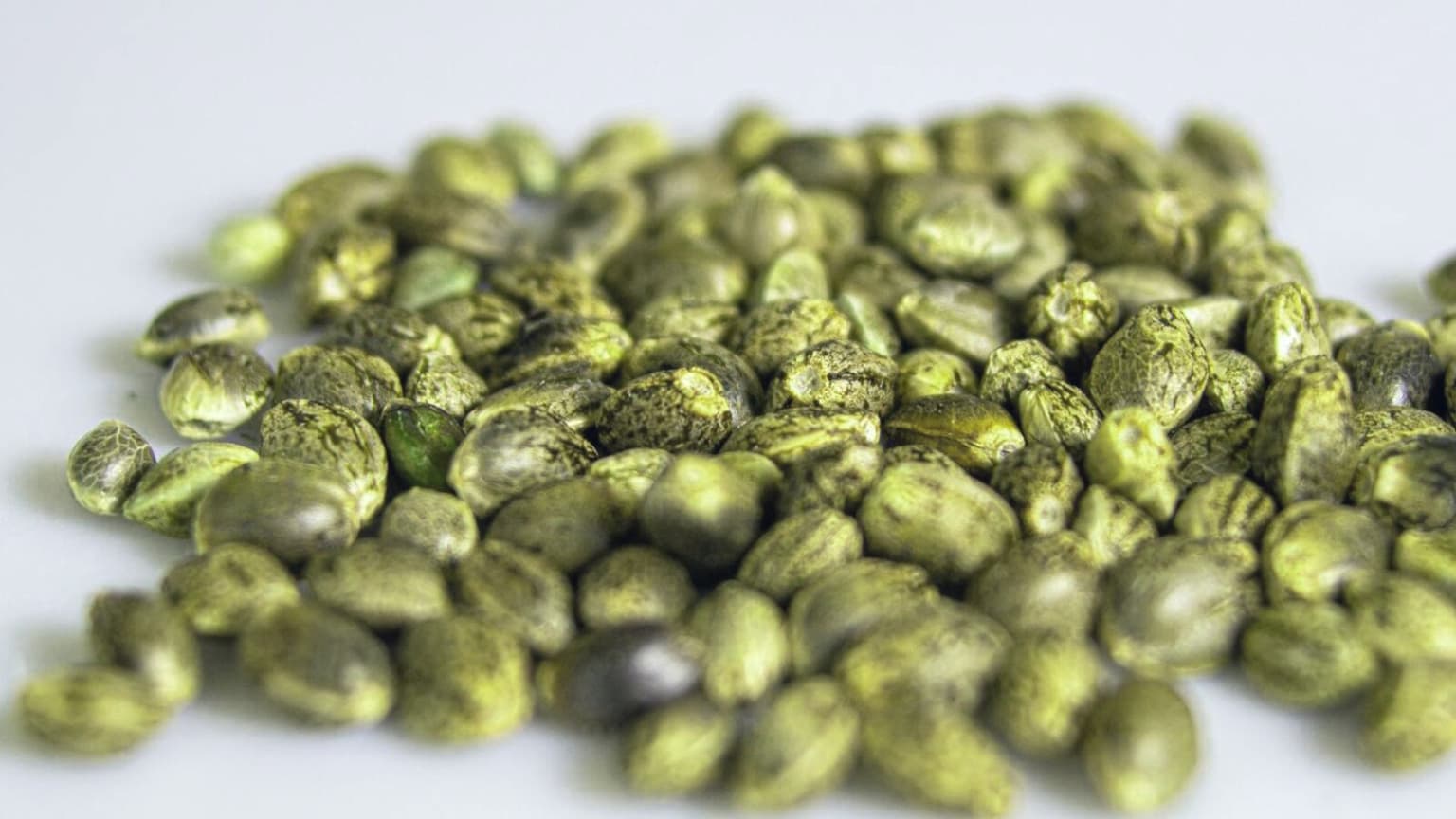
- Pale, chalky, or whitish coloring. Healthy seeds are dark brown to nearly black with slight mottling. Pale seeds have suffered lipid oxidation.
- Crushed or split seed coat. Mechanical damage from freeze-thaw cycles or rough handling. The embryo may be fine or may be exposed — test immediately.
- Soft or spongy when gently squeezed. Healthy seeds are firm. Softness indicates moisture intrusion and potentially active fungal growth inside the testa.
- Visible mold or white fuzz on the exterior. Container humidity exceeded 70% RH or seeds were not dry before sealing. Mold from the outside can penetrate. Discard molded seeds entirely.
- Seeds float for more than 2 hours in water. The water float test is imprecise but extreme floaters (24 hours still floating) are statistically more likely to be non-viable. Not a perfect test — many viable seeds float.
- Silica gel turned fully pink with no recent inspection. If you open a container and the silica is fully saturated, seeds have been sitting in elevated humidity for an unknown period. Test germinate immediately.
Sourcing Seeds Worth Storing: Genetics and Viability at Purchase
The viability ceiling of any seed batch is set at harvest. Seeds from a reputable breeder who harvested at peak maturity, dried correctly, and shipped with desiccant can realistically hit 95%+ germination rates fresh out of the pack. Seeds from bulk discount suppliers that were harvested prematurely (the "green" seed problem) or mishandled in transit may arrive at 60–70% germination before you've stored them a single day.
Established seed banks — including Barney's Farm, Royal Queen Seeds, and Fast Buds — document their seed handling and storage protocols and generally ship with breeder packs sealed against moisture. When building a collection you intend to store for years, starting with a high-viability batch is the single most important upstream decision.
If you're building a long-term stash, browsing our beginner-friendly seeds collection or the full seed bank directory is a good starting point for finding genetics with documented germination guarantees. High-THC photoperiod lines like those in the high-THC seed catalog and the indoor seed collection are the most commonly banked genetics — precisely because they represent years of breeder development that growers want to preserve.
Frequently Asked Questions About Cannabis Seed Storage
How long can cannabis seeds realistically stay viable?
Cannabis seeds stored at 41°F in a sealed, dark container with silica gel routinely retain 85–95% germination rates at the 5-year mark, and documented collector accounts show viable seeds at 10+ years under these conditions.
The baseline is set by seed physiology: at low temperatures and moisture levels, embryo metabolism slows to near-zero. The limiting factor becomes lipid oxidation in the cotyledon cells — a slow process at cold temperatures. Seeds stored in paper envelopes at room temperature typically fall below 50% germination by year three, sometimes earlier if the storage environment sees summer heat spikes.
Should I store cannabis seeds in the fridge or freezer?
For most growers, the refrigerator at 38–41°F is the better choice — it delivers 90%+ of the longevity benefit of freezing with none of the condensation risk on retrieval.
Freezer storage can extend viability to 15–20+ years but requires seeds dried below 5% moisture, double-sealed containers, and a slow two-stage warm-up protocol. Skipping any step causes catastrophic condensation and embryo death. If you're not confident in the preparation protocol, the fridge is safer and nearly as effective for 5–10 year horizons.
Can I store cannabis seeds at room temperature?
Room temperature storage works for weeks to a few months, but viability degrades measurably within a year and significantly by year two — especially in homes that reach 80°F+ in summer.
Aggregated grower reports consistently document 40–60% germination rates at the 2-year mark for room-temperature seeds stored in paper breeder packs. If you're planting within a season, room temperature is fine. For anything beyond 6 months, move the seeds to a refrigerator.
Do I need silica gel packets for seed storage?
Yes — silica gel is non-negotiable for any storage beyond a few weeks. Even an airtight container without desiccant will equilibrate to whatever moisture content the seeds carried when sealed.
Use 1–2 g of indicating silica gel (blue = dry, pink = saturated) per 20–30 seeds in a small vial. For larger containers, scale up proportionally. Check the color every 6–12 months. If it turns pink, remove seeds to a temporary container, recharge the silica gel at 250°F for 2 hours, and reseal. Boveda and Dry & Dry are two widely available brands with consistent specs.
Why are my stored seeds not germinating after 2 years?
The most likely causes, in order of frequency: humidity exposure (moisture intrusion), temperature spikes during storage, and UV light damage from clear containers — not age.
Check whether the silica gel was still blue when you opened the container (if it was pink, humidity was too high). Recall whether the storage location experienced summer heat over 80°F. Check the seed color — pale or chalky appearance indicates lipid oxidation from heat or light. If seeds look dark and firm but still fail to germinate, try the warm soak and paper-towel method with tap water pH'd to 6.0–6.5, keeping temperature at 77°F for 48–72 hours.
Is it okay to store feminized seeds the same way as regular seeds?
Yes — feminized seeds, regular seeds, and autoflower seeds all follow the same storage principles. The method does not affect storage requirements.
Seed type (feminized vs. regular vs. autoflower) affects genetics and germination behavior, not physical seed structure or storage chemistry. A feminized seed from a quality producer stores identically to a regular seed from the same parent line. What matters is moisture content, temperature, and light exposure — not whether the seed carries the XX chromosomal expression.
Can I use a Boveda humidity pack instead of silica gel for seed storage?
Boveda packs are designed to maintain a specific RH (62%, 58%, etc.) — too high for long-term seed storage, which targets 5–8% seed moisture content, not ambient RH above 30%.
Boveda packs work excellently for cured flower storage. For seeds, you want a desiccant that actively pulls moisture down, not one that buffers to a fixed humidity level. Indicating silica gel is the correct product for seed storage. If you already have Boveda packs, do not place them in a seed vial — they will add humidity, not remove it.
How do I know if old seeds are still worth germinating?
Visual inspection first: dark, firm, tiger-striped seeds are worth attempting. Pale, crushed, or soft seeds are likely dead. For borderline batches, germinate 2–3 test seeds before committing the whole batch.
The water float test (viable seeds sink within 1–2 hours) gives rough guidance but is not definitive — many viable seeds float. The most reliable test is a paper-towel germination at 77°F with 2–3 seeds from the batch. If 2 out of 3 show a taproot within 72–96 hours, the batch is still worth using. If 0 out of 3 germinate at 96 hours, the batch is likely dead.
What is the best container for long-term cannabis seed storage?
Dark (amber or brown) borosilicate glass vials with rubber stopper caps, containing 1–2 g of indicating silica gel, stored inside a second opaque airtight container — this is the collector standard for 5–10+ year storage.
The glass vial provides a chemically inert, UV-blocking, airtight primary barrier. The secondary container adds redundancy against light and moisture. Clear glass or plastic containers allow UV transmission, which degrades seed coat lipids. Zip-lock bags are permeable to moisture vapor over time and provide no UV protection — fine for days, not years.
Does seed storage affect germination speed when I'm ready to grow?
Correctly stored seeds germinate at the same rate and speed as fresh seeds — the cold and dry storage environment is reversible. Poorly stored seeds may germinate more slowly or unevenly due to embryo stress.
When pulling seeds from cold storage, the two-hour room-temperature equilibration period before germination (even for fridge-stored seeds) helps avoid the micro-condensation shock that can slow germination. Once at room temperature and started in your preferred germination medium — paper towel, direct soil, or a Rapid Rooter — properly stored seeds perform identically to fresh stock. Poorly stored seeds that are still viable often show delayed germination (96–120 hours vs. 48–72 hours) and occasionally produce stretched seedlings as the embryo deploys reserves less efficiently.
How should I store seeds from my own harvest?
Home-harvested seeds need 1–2 weeks of ambient drying at 60–65°F before sealing — green or immature seeds sealed immediately will off-gas moisture and fail within months.
Seeds harvested from a plant that went to full maturity (calyxes swelling, pistils turning, the seed's tiger-stripe pattern fully developed) are the best candidates for long-term storage. Squeeze each seed gently — it should feel firm and click slightly, not compress or crumble. Lay seeds on a paper towel in a dark, ventilated space for 10–14 days before moving them into glass vials with silica. From that point, the same protocol applies: fridge, dark, and labeled.
The Long Game: Why Proper Storage Is an Investment, Not a Chore
Cannabis genetics are not infinitely reproducible. A line that a breeder stops producing, a limited F1 cross, a pheno you selected from a 10-pack and grew for three seasons before banking seeds — these are genuinely irreplaceable without proper storage. Consistent across collector-community discussions spanning r/microgrowery, the International Cannagraphic Magazine forums, and the Seedfinder forum archives is one observation: growers who lost collections to improper storage report it as one of the most preventable mistakes in a decade of growing.
The material cost of doing this correctly is under $30: a pack of amber vials from a lab supply site, a bag of indicating silica gel, and a dedicated shelf at the back of the refrigerator. The return on that investment — genetics preserved across five, eight, ten years — scales with the quality of what you're storing.
If you're starting fresh, browse outdoor-suited genetics or autoflower seeds worth banking for next season. If you already have a collection worth protecting, the protocol above is the one that experienced collectors actually use. Dark, cold, dry, and documented — that's the whole system.
- Dark: UV kills lipids. Use amber glass, never clear.
- Cold: 41°F (fridge) is the practical sweet spot. Every 18°F drop doubles longevity (Harrington's Rule).
- Dry: 5–8% seed moisture content. Indicating silica gel is your moisture alarm.
- Documented: Label every vial with strain, source, seal date, and test germination results.

Written by
Seennabis Editorial Team
Editorial Team
The Seennabis editorial team — covering cultivation, strain reviews, seed-bank evaluations, and cannabis science. Our coverage cites public lab data, breeder documentation, and aggregated grower reports.
More from Seennabis →