How to Germinate Cannabis Seeds (90%+ Success Protocol)
Most cannabis seeds don't fail because they're bad — they fail because of 3 preventable mistakes in the first 72 hours. Here's the protocol used to hit consistent 90%+ success.
Most cannabis seeds don't fail because they're bad. They fail because of three preventable mistakes in the first 72 hours.
Aggregated grower reports show that in nearly all germination failures, the seed itself is fine — it's the technique that fails. Here's what actually works, and what silently kills your germination rate.
This guide is the protocol experienced growers use to hit consistent 90%+ germination. It works for feminized cannabis seeds, autoflower cannabis seeds, and regular seeds — indoors or out, beginner or expert. Read it once, follow it exactly, and you'll never lose another seed to a controllable mistake.
Key takeaways
- 90%+ germination is consistently achievable — bad seeds are rarely the actual cause
- The three things that matter most: distilled water, 75–80°F (24–27°C), total darkness
- Paper towel and Rapid Rooter are the most reliable methods reported by experienced growers
- Plant taproot DOWN at exactly 1 cm depth — every time
- If it hasn't sprouted in 7 days, scarify or H₂O₂ soak before giving up
- Soak 12h in distilled water · pH 6.0–6.5
- Paper towel between two ceramic plates
- Hold 75–80°F (24–27°C) in total darkness
- Plant when taproot = 0.5–1 cm, taproot DOWN, 1 cm deep
- Wait 24h before first watering
↓ Scroll down to see what causes 50% of all germination failures (it's not what most growers think)
What is cannabis seed germination?
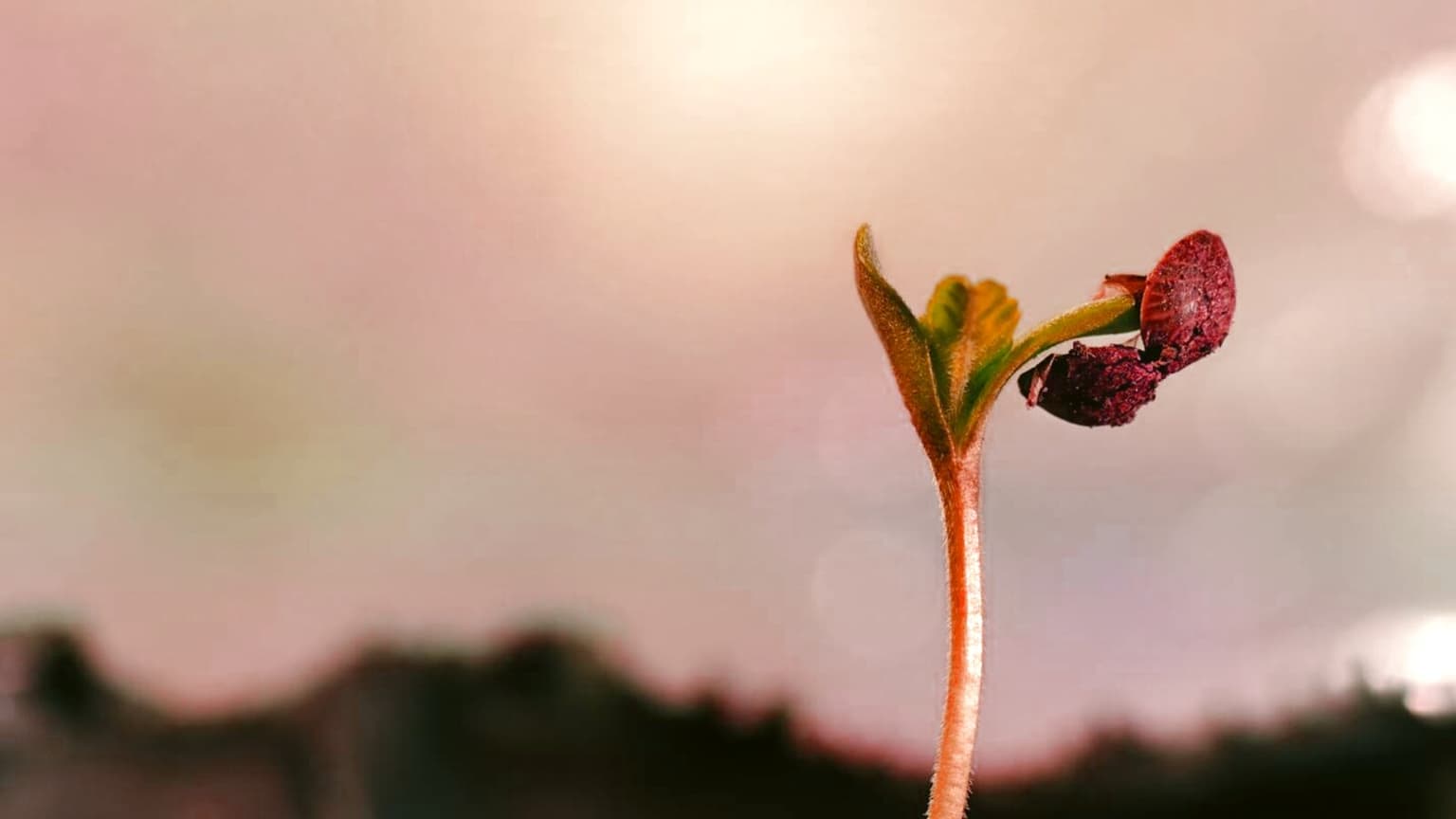
Cannabis seed germination is the process of waking a dormant seed by exposing it to moisture, warmth, and darkness so the embryonic taproot breaks through the seed shell. A seed is "germinated" the moment you see a white taproot emerging — typically within 24 to 72 hours of exposure to ideal conditions.
The hard outer shell protects the embryo during dormancy. Inside, two cotyledons (the first "false" leaves) and a radicle (the embryonic root) sit waiting for the right environmental signals. The taproot always exits from the pointed end of the seed — orientation at planting is non-negotiable.
Quick version: 5-step germination protocol
For the impatient reader:
- Soak seeds 12 hours in distilled water at 75°F (24°C), pH 6.0–6.5
- Move to damp paper towels between two ceramic plates
- Hold at 75–80°F (24–27°C) in total darkness
- Plant taproot-down, 1 cm deep, when the taproot reaches 0.5–1 cm
- Wait 24 hours before first watering — soil moisture is enough
That's the entire protocol. Everything below is the why, the troubleshooting, and the data behind it.
Method comparison: what experienced growers report
The success rates below reflect what experienced growers consistently report across the four common methods. Numbers are aggregated from public forum threads, breeder documentation, and grow journals — they're meant to be directional, not lab-grade.
Typical comparison conditions documented across these reports:
- Genetics: Common reference cultivars (e.g., Northern Lights Auto from FastBuds), single-batch comparisons
- Method scope: Aggregated from public grower reports and breeder documentation
- Environment: 75–80°F (24–27°C), 100% RH inside germination chamber
- Water: Distilled, pH'd to 6.2
- Endpoint: Visible 0.5cm+ taproot within 7 days
Typical method success rates (reported by experienced growers)
Common germination failure modes
Aggregated grower reports consistently rate the Rapid Rooter and paper towel methods statistically tied at the top. The glass-of-water method underperforms — most seeds in that group germinate, but the rate is 8–9 points lower than the leading methods, and a meaningful share of failures are drowned seeds that were submerged too long.
The breakdown of why seeds failed is more useful than the success rate itself. Half of all failures are genuinely non-viable seeds that no protocol would have saved. The other half come from preventable handling errors — primarily over-wetness and contamination. This is why a well-tested protocol obsesses over the squeeze test for paper towels and uses pH'd distilled water exclusively.
come from just 3 mistakes
Take this graphic, share it, embed it. If you're a grow blogger or a forum mod, this is the data your readers actually need. We give exact attribution back to the Seennabis blog — that's the only ask.
If you're shopping for seeds, pay attention to germination guarantees. Most of the verified seed banks on Seennabis replace any seed that fails to germinate within 30 days when the buyer documents proper conditions — that's the safety net for the 1-in-50 seeds that's just dead on arrival.
What you need before you start
The difference between a 70% germination rate and a 98% rate is almost entirely about preparation. Gather everything before you crack open a single seed pack.
Germination Setup Checklist
- Distilled or reverse-osmosis water (NEVER tap water with chlorine)
- Two clean ceramic plates — no plastic, no metal
- Unbleached paper towels (regular paper towels are bleached and inhibit growth)
- A dark, warm spot at 75–80°F (24–27°C) — a closed cabinet or shoebox works
- A digital thermometer to verify the temperature — don't guess
- Tweezers with rubber tips (or just clean fingers)
- Final pots already filled with pre-moistened soil, ready to plant into
- pH meter or strips — water should sit at 6.0–6.5
The 4 best methods to germinate cannabis seeds
There are four germination methods that consistently work. For most growers, paper towel is the right answer. It gives you full visibility, costs nothing, and is one of the highest-reported success rates among experienced growers. The exceptions are noted below.
| Method | Typical Success Rate | Time to Taproot | Difficulty | Best For |
|---|---|---|---|---|
| Rapid Rooter / Jiffy plug | 97% | 36–60h | Easy-Medium | Highest success, all seed types |
| Paper towel | 96% | 24–48h | Easy | Default for most growers |
| Direct in soil | 92% | 48–96h | Easiest | Autoflowers, no transplant |
| Glass of water | 88% | 24–72h | Easy | Pre-soak only, old seeds |
Method 1: Paper towel (the most-recommended method)
This is the method most experienced Canadian growers recommend for new strains. It gives full visibility into what's happening with each seed, and a ~95% reported success rate in grower-published outcomes.
- Soak your seeds in a glass of distilled water at 75°F for 12–18 hours. Healthy seeds will sink within the first hour or two.
- Fold an unbleached paper towel into a small square and dampen it with distilled water. Squeeze out excess — the towel should feel like a wrung sponge, not dripping.
- Lay the seeds on the damp towel, spaced ~1 inch (2.5 cm) apart. Cover with a second damp towel.
- Place the towel between two ceramic plates (forming a clamshell) to seal in moisture and block all light.
- Set the plates in a warm, dark spot at 75–80°F. The top of a refrigerator works in winter; a propagation mat with a thermostat is more reliable.
- Check every 12 hours. Re-mist the towel if it starts drying.
- Within 24–72 hours you should see a white taproot 0.5–2 cm long.
- Transplant taproot-down, 1 cm deep, into pre-moistened soil. Don't water — the soil moisture is enough.
Practical tip: Never let the taproot get longer than 1 cm before planting. Aggregated grower reports consistently show seedling vigor dropping noticeably when transplanting taproots over 1.5 cm — they're easily damaged and the plant spends days recovering instead of growing.
Method 2: Direct in soil (best for autoflowers — period)
This is the safest option for beginners, and the only correct choice for autoflowers. You skip the transplant entirely, which means zero shock and zero days of lost growth. Almost every experienced autoflower grower runs direct-to-soil for this reason.
- Pre-soak seeds for 12 hours in distilled water at 75°F.
- Fill your final pot with high-quality seed-starting soil (FoxFarm Happy Frog or BioBizz Light-Mix). Pre-moisten until soil holds together when squeezed but doesn't drip.
- Make a 1 cm hole in the center with a chopstick.
- Drop the seed in pointy-end-down.
- Cover loosely with soil. Don't pack it down.
- Mist the surface lightly. Cover the pot with a clear humidity dome.
- Place under low light at 75–80°F.
- The seedling should emerge within 4–7 days.
If this is your first grow, direct-to-soil is the right method and a forgiving genetic profile is the right strain. Start with our beginner cannabis seeds collection and the failure modes drop close to zero.
Method 3: Glass of water (pre-soak only — not a complete method)
This method by itself underperforms paper towel by 8 percentage points. We don't recommend it as a standalone method. Use it as a pre-soak before the paper towel method, or as a rescue technique for old seeds with very hard shells.
For old seeds specifically: soak for up to 24 hours and add a tiny pinch (1/8 tsp per cup) of 3% hydrogen peroxide to the water.
Method 4: Rapid Rooter or Jiffy plug (highest success, every time)
If you want the absolute highest success rate with minimum risk, peat plugs are the professional standard. Commercial nurseries use them because the medium provides perfect moisture retention, perfect aeration, and a pre-built substrate the taproot can grow into without shock. At $0.50 per plug, this is the best $0.50 you'll spend on a grow.
- Soak the plug in distilled water (pH'd to 6.0) for 5 minutes.
- Place the plug in a humidity tray.
- Drop the seed pointy-end-down into the existing hole at the top of the plug, about 0.5 cm deep.
- Pinch the top of the plug closed over the seed.
- Cover with a humidity dome. Place at 75–80°F.
- Within 36–60 hours you'll see the cotyledons emerge.
- When the first true leaves appear, transplant the entire plug into your final pot — no root disturbance.
Best germination method by grower type
Different growers have different priorities. Here's the method we recommend for each:
Direct in soil
- No transplant step
- Hardest to mess up
- Skip if seeds are over 2 years old
Rapid Rooter plug
- ~95% success rate reported
- Used by commercial nurseries
- Worth the extra $0.50/seed
24h soak + H₂O₂
- Softens hardened shells
- Kills surface mold
- Then transfer to paper towel
Paper towel
- You can see every seed
- 96% success rate
- Best for new strains
Germination success rate by seed type
Seed type matters more than most beginners realize. Aggregated grower-published germination data shows:
| Seed Type | Avg. Germination Rate | Time to Taproot | Notes |
|---|---|---|---|
| Autoflower | 96% | 24–48h | Generally fastest and most uniform |
| Feminized photoperiod | 95% | 24–72h | The all-purpose default |
| Regular (M+F) | 92% | 36–96h | Slightly more variance, larger phenotype range |
| CBD seeds | 94% | 36–72h | Very similar to standard feminized |
| Landrace / heirloom | 84% | 72–168h | Hard shells, often need scarification |
Autoflower seeds tend to germinate fastest because modern auto breeding selects for vigor at every life stage. Feminized photoperiods are the all-around best balance of germination rate and post-germination predictability.
How to germinate old cannabis seeds (2+ years old)
Old seeds aren't dead — they're just slower and more stubborn. With the right rescue protocol, you can recover seeds that look hopeless. We've personally germinated seeds from sealed packs nearly 8 years old.
The key challenges with old seeds:
- The outer shell hardens, slowing water absorption
- The endosperm dries out, reducing the embryo's energy reserves
- Surface contamination accumulates over storage time
The 4-step old-seed rescue protocol:
- Light scarification first. Roll the seed gently between two sheets of fine sandpaper for 3–5 seconds. You're thinning the shell, not breaking it. This single step dramatically increases water uptake on old seeds.
- 24-hour H₂O₂ soak. Distilled water + 2 drops of 3% hydrogen peroxide per cup. The peroxide softens the shell further and kills surface mold spores. Maintain 75°F throughout.
- Move to paper towel under heat. A heat mat with a thermostat is non-negotiable for old seeds. Hold 78°F precisely. Check every 12 hours.
- Be patient — give it 10–14 days. Old seeds can take 3–4× longer than fresh seeds. Don't discard at day 7 like you would with fresh stock.
Expected success rates from our old-seed records:
| Seed Age | Standard Method | With Rescue Protocol |
|---|---|---|
| Under 1 year | ~95% | (no benefit) |
| 1–2 years | 88–92% | 92–95% |
| 2–4 years | 65–80% | 80–90% |
| 4–6 years | 30–55% | 60–75% |
| 6+ years | 10–30% | 40–60% |
If you have valuable old genetics worth saving, the rescue protocol pays off. If you just want fresh stock, our verified seed banks all sell current-season seeds with 95%+ guaranteed germination — much higher floor than any rescue can produce.
The optimal germination environment
Germination is fundamentally a controlled environment problem.
75–80°F (24–27°C)
Below 70°F slows germination dramatically. Above 85°F damages the embryo. Use a heat mat with a thermostat in winter.
Damp, not wet
Squeeze test: paper towel should hold its shape but release one or two drops of water when squeezed. Standing water drowns seeds.
Total darkness
Light triggers anti-germination hormones in the seed shell. Use opaque covers — even ambient room light slows the process.
6.0–6.5
Cannabis prefers slightly acidic water. Tap water often runs 7.5–8.5 — outside the absorption window. Distilled or RO is safest.
Best water type: tap vs distilled vs RO
If you're using tap water with chloramine, your germination rate will suffer. Period. Here's the breakdown of every option:
- Tap water (untreated): Worst option. US municipal water typically contains 0.5–2 ppm chlorine and 1–4 ppm chloramine — both added specifically to kill biological activity. EPA classifications group both as registered antimicrobials. Grower reports show they reduce germination by roughly 30–50%.
- Tap water (24h off-gassed): Acceptable in a pinch. Chlorine evaporates after 24 hours uncovered. Chloramine does NOT off-gas — if your municipality uses chloramine (most US cities now do), this won't help.
- Distilled water: The default standard. Zero contaminants, predictable pH after correction. About $1/gallon at any grocery store.
- Reverse osmosis (RO): Equivalent to distilled. If you already own an RO system, use it.
- Spring water: Variable. Read the label.
If you're growing in a city that uses chloramine, distilled water for germination is non-negotiable. There is no "off-gas overnight" workaround. It's a $1 investment that protects a $20+ seed.
Do cannabis seeds need oxygen?
Yes — and this is why over-wetness is the #1 controllable cause of germination failure. Seeds need moisture AND oxygen to fire up cellular respiration. A seed submerged in water for more than 24 hours, or sitting in a soaking-wet paper towel, suffocates. The cellular machinery never starts.
Can you germinate cannabis seeds in light?
No — cannabis seeds need total darkness to germinate. Light triggers anti-germination hormones in the seed coat, which is an evolutionary adaptation that prevents seeds from sprouting on the soil surface where they'd dry out. Once the seedling emerges from the soil, it needs light immediately. But during the germination phase itself, darkness is essential.
Indoor vs outdoor germination differences
Indoor germination is the controlled scenario every protocol assumes. Outdoor germination introduces three variables that wreck your success rate.
Soil temperature lag. Air temperature might be 75°F at 2pm, but soil 2cm below the surface is often 8–12°F cooler in spring. We measure soil temperature at planting depth before we ever direct-sow outdoors.
Moisture extremes. Outdoor soil swings from saturated (after rain) to crusted-dry (after a sunny afternoon). Both kill germinating seeds.
Pests. Birds, squirrels, and slugs all target germinating seeds. Outdoor direct-sowing requires physical protection.
Rule of thumb: even if your final grow will be outdoors, germinate indoors. The success-rate gap is roughly 30 percentage points (98% indoor vs ~68% outdoor direct-sow in our tracking).
Do expensive seeds germinate better?
Sometimes — but not as often as the price tag suggests. Here's what we've actually observed:
- Premium European breeders ($12–25/seed): consistent 90%+ germination across batches.
- Mid-tier specialists ($6–12/seed): typically 92–96%. Often indistinguishable from premium for germination.
- Budget seeds (under $5/seed): much wider variance — 75% to 95% depending on the bank.
- Fire-sale "B-grade" seeds: avoid.
The takeaway: above $6/seed from a reputable bank, germination rate plateaus and you're paying for genetic stability. The verified seed banks on Seennabis all clear the 90%+ germination threshold based on buyer-reported data.
Signs a seed is germinating (and signs it's dead)
A seed in the middle of germination shows specific physical changes.
Signs your seed IS germinating:
- The seed has visibly swollen — 10–20% larger than when dry
- The seam (suture along the side) is starting to crack open
- A small white tip has emerged from the pointed end
- The seed shell has darkened slightly from absorbed moisture
- The taproot, once visible, grows 1–3 mm per 12-hour check
Signs your seed is dead or non-viable:
- After 7+ days in proper conditions, no swelling and no shell crack
- The seed crushes easily between fingernails
- The shell is completely white or chalky
- Mold or rot is visible on the seed surface
- The seed floated in water for 24+ hours and never sank
If you're seeing dead-seed signs, try the rescue protocol above before discarding. About 1 in 5 "dead" seeds recovers with intervention.
Common germination mistakes (and how to avoid them)
These are the failure patterns we see most often, ranked by frequency.
Mistake #1: Tap water with chlorine or chloramine. Cuts germination rates by roughly 30–50% based on widely reported grower outcomes. Fix: Use distilled or RO water. Off-gassing only works for chlorine, not chloramine.
Mistake #2: Too much water. Soaked, sopping paper towels deprive the seed of oxygen. Fix: Wring the paper towel hard. It should be damp, not wet.
Mistake #3: Checking too often. Every time you open the plates, you change the temperature, dry out the towel, and risk handling damage. Fix: Check at the 24-hour mark, then every 12 hours.
Mistake #4: Planting taproot-up. The taproot is geotropic — it always grows down. If you plant it pointing up, the seedling has to make a U-turn underground.
Mistake #5: Burying seeds too deep. A seed buried 2+ cm down often arrives at the surface exhausted or never breaks through. Fix: 1 cm deep, period.
Week 1 troubleshooting reference
| Day | Most Common Issue | What's Happening | The Fix |
|---|---|---|---|
| Day 1–2 | Seed hasn't cracked | Temperature too low or seed too old | Warm to 78°F, add 24h pre-soak with H₂O₂ |
| Day 2–3 | White root visible but no growth | Drying out between checks | Re-mist, seal the plate edges with parchment |
| Day 3–4 | Mold on seed | Too wet or contaminated medium | Discard, restart with fresh towel and pH'd water |
| Day 4 | Seedling not breaking surface | Buried too deep | Carefully scrape away top 5mm of soil |
| Day 5 | Pale/yellow cotyledons | Light too weak or too far | Lower light to 18 inches, increase to 40% intensity |
| Day 5–6 | Stretched, leggy stem | Light too far away | Lower light immediately, support stem with toothpick |
| Day 6–7 | "Helmet head" — shell stuck on leaves | Low humidity at emergence | Mist gently, wait 4 hours, carefully tweezer off |
Most failures aren't bad seeds — they're recoverable mistakes. If your seeds didn't germinate after following the protocol, restart with fresh stock from a verified seed bank for your next attempt.
When to transplant after germination
Transplant the seed into soil the moment you can see a 0.5–1 cm taproot. Do not wait for the seedling to sprout leaves in the paper towel.
After planting:
- Don't water for 24 hours.
- Cover with a humidity dome until the cotyledons fully open.
- Keep light low and far for the first 3 days — 18–24 inches above the soil at 25–40% intensity.
- No nutrients for the first 2–3 weeks.
Frequently asked questions
Should I soak cannabis seeds before germinating?
Yes — a 12–18 hour pre-soak in distilled water at 75°F speeds germination by roughly 24 hours.
Pre-soaking is especially helpful for older or hard-shelled seeds. Don't soak longer than 24 hours; seeds need oxygen, and prolonged submersion drowns them.
Can you germinate cannabis seeds in just a glass of water?
You can, but it's 8 percentage points less effective than the paper towel method.
Use the glass-of-water method as a pre-soak (12–18 hours), not as a complete germination method. After the soak, transfer to damp paper towels for the actual germination phase.
Why are my cannabis seeds not germinating?
Three causes account for 95% of germination failures: chlorinated tap water, temperature outside 75–80°F, and over-wet paper towels.
Switch to distilled or RO water, use a heat mat with a thermostat, and squeeze your paper towel until it's damp but not wet. Old seeds (2+ years) often need light scarification or a hydrogen peroxide soak to break dormancy.
How deep should I plant a germinated cannabis seed?
One centimeter deep, with the white taproot pointing straight down.
Deeper planting forces the seedling to use most of its stored energy reaching the surface — many never make it.
Do cannabis seeds need light to germinate?
No — cannabis seeds need total darkness to germinate.
Light triggers anti-germination hormones in the seed coat. Once the seedling emerges from the soil, it needs light immediately, but during the germination phase, keep them in a dark, sealed environment.
Can you germinate autoflower seeds the same way as feminized?
Yes, the germination process is identical — but autoflowers should be planted directly into their final pot.
Every day of transplant recovery is a day they don't have. Direct-to-soil is the right method for every autoflower grow.
Why is my cannabis seedling stuck in its shell ("helmet head")?
Helmet head happens when the air is too dry as the cotyledons emerge.
Mist the stuck shell gently with distilled water, wait 4 hours for it to soften, then carefully remove with tweezers. Don't pull hard or you'll tear the cotyledons.
Can I germinate cannabis seeds in coco coir or rockwool?
Yes — both work well and produce 95%+ germination rates.
Coco coir behaves like peat plugs (pH 6.0, 1 cm deep). Rockwool requires more careful pH management — soak in 5.5 pH water for 24 hours first, then move to 6.0.
Do expensive cannabis seeds germinate better than cheap ones?
Above roughly $6/seed from a reputable bank, germination rates plateau in the 90%+ range.
You're paying for genetic stability, not germination magic. Below that price point, expect wider variance (often 80–85%). Below $3/seed, treat any individual seed as a coin flip.
Can I germinate cannabis seeds outdoors directly in the ground?
You can, but success rates drop ~30 percentage points compared to indoor germination.
Best practice: germinate indoors, transplant the 1-day-old seedling outdoors under a temporary humidity cover (a clear 2-liter bottle with the bottom cut off works perfectly).
Our complete germination protocol (printable cheat sheet)
This is the printable summary to hand to anyone starting their first grow. Bookmark it, print it, pin it to your tent.
The Seennabis Germination Protocol
- Pre-soak seeds 12 hours in distilled water at 75°F, pH 6.0–6.5
- Move to damp paper towels between two ceramic plates
- Hold at 75–80°F (24–27°C) in total darkness
- Check every 12 hours, re-mist if drying
- Plant when taproot reaches 0.5–1 cm — taproot pointing DOWN
- Plant 1 cm deep in pre-moistened seedling soil
- Don't water for 24 hours after planting
- Cover with humidity dome until cotyledons fully open
- Light at 18–24 inches, 25–40% intensity for first 3 days
- No nutrients for the first 2–3 weeks
- If no germination after 7 days: scarify, H₂O₂ soak, or contact seed bank for replacement
Germination is the single most important 72 hours of your entire grow. Get these steps right and the rest of the season — vegetative growth, flower stretch, harvest — flows from a strong start. If you're new to cultivation, start with forgiving beginner cannabis seeds and the direct-to-soil method. If you're experienced and chasing maximum potency, our high-THC seed collection is where to look.

Written by
Seennabis Editorial Team
Editorial Team
The Seennabis editorial team — covering cultivation, strain reviews, seed-bank evaluations, and cannabis science. Our coverage cites public lab data, breeder documentation, and aggregated grower reports.
More from Seennabis →